
From Thermal Engineering to Mining Truck Bodies: Why We Solve Weld Cracking Through Stress Control
When a heavy-duty mining dump truck body fails, the crack rarely starts in the middle of a steel plate. It starts at the weld seam — specifically, in the Heat Affected Zone.
That's not a mining problem. That's a metallurgy problem.
And it's the problem we've been solving for over a decade — not in mining, but in lead oxide production lines, where high-temperature stress and crystalline structure changes are daily engineering realities.
The Overlooked Root Cause
Most structural failures in mining truck bodies are blamed on overloads or rough haul roads. But our analysis of field failures tells a different story: the crack initiates at the HAZ, not at the point of peak mechanical load.
This is not a guess. It comes from years of thermal engineering work — designing equipment that handles high-temperature stress cycles day after day.
We didn't start as a mining equipment manufacturer. But we understand what happens to steel under heat and stress. And that understanding now drives how we build heavy-duty mining dump truck bodies.
One Product Line: 50–100 Ton Class Truck Bodies
We currently manufacture heavy-duty mining dump truck bodies for 50-ton to 100-ton mechanical drive mining trucks , covering major chassis platforms including Caterpillar, Komatsu, BelAZ, and XCMG.
Key specifications:
- Floor plate: 16–20mm NM450 + 10mm wear liner
- Side plate: 10–12mm NM400
- Heaped capacity (SAE 2:1): 35–45 cubic meters
- Loading height: optimized for 5–6m hydraulic excavator drop
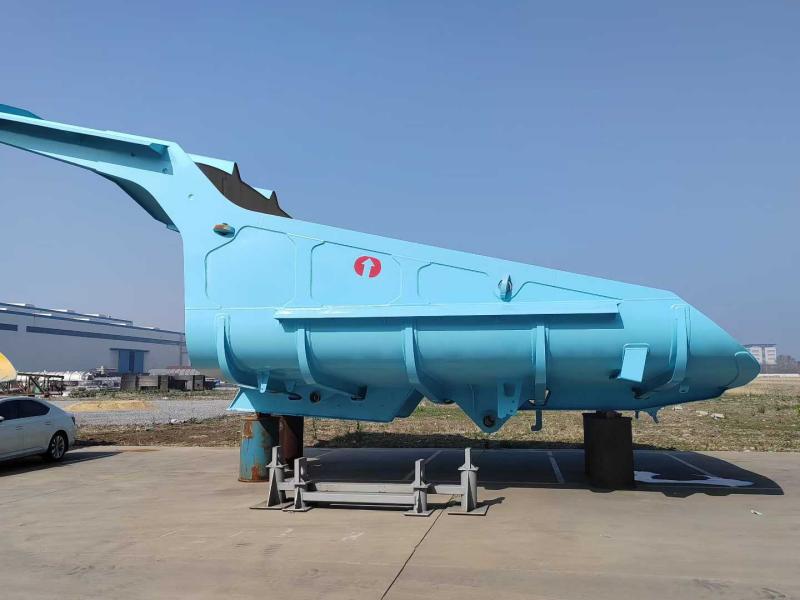
Unlike traditional flat-bottom rectangular bodies, our design uses a gateless, scoop-type profile with a continuously curved floor.
Why? Because conventional flat floors retain 3–5 tons of sticky material per cycle — and that's three to five tons of lost payload, plus manual cleanout labor.
Three Technical Foundations
1. The 13° Continuous Slope ("Live Floor")
The floor rises continuously at 13 degrees from the cab guard to the rear tip. When the hoist engages, gravity does the work — the load fractures and slides in one motion. No digging. No hammering. No carry-back.
2. Bi-Grade Material Strategy: NM400 + NM450
We do not use a single steel grade for the entire body. The wear profile is not uniform — so the material specification should not be either.
| Zone | Grade | Hardness (HB) | Yield Strength | Function |
|---|---|---|---|---|
| Floor & lower sidewalls (high wear) | NM450 | 420–480 | ≥1000 MPa | Sliding abrasion resistance |
| Upper sidewalls & front canopy (high impact) | NM400 | 360–440 | ≥900 MPa | Impact absorption, weld stability |
This combination is designed to handle 500kg+ boulders dropping from height (NM400 absorbs the shock) while the floor withstands continuous dragging abrasion (NM450 resists wear).
Welding requirements: NM400 requires preheating to 150°C; NM450 demands stricter parameter control.
3. Five-Longitudinal, Nine-Transverse Rib Skeleton
FEA simulations showed that stress fractures typically start at weld seams between the floor and stiffeners. Our response: integrate the supporting structure into the shell.
The external "five longitudinal, nine cross" lattice design acts as a truss, distributing 60+ tons of load mass across the entire chassis rail. This prevents the "banana peel" warping common in competitor products.
Additional Functional Design Elements
Front canopy at 45°: Two purposes — deflect falling boulders away from the cab, and increase struck capacity without raising the center of gravity.
Reinforced rear edge: Fitted with a double-thick NM450 wear strip. Mining sites commonly back-drag to clean dump pads. This design prevents rear edge deformation and maintains proper sealing if a tailgate is equipped.
Quality Control + Global Delivery
Every body undergoes magnetic particle inspection (MPI) before sandblasting and painting to detect subsurface weld flaws. Post-weld stress relief heat treatment is standard.
Shipping: Single-unit welded construction. Flat rack containers or break-bulk vessels. Two-component epoxy primer (corrosion protection for sea freight) plus polyurethane top coat (UV resistance).
On-site support: We provide technical guidance for first-time installations.
Why This Matters
The mining industry spends millions on wear plates and structural repairs. But most of that spending addresses symptoms, not root causes.
We approach the heavy-duty mining dump truck body as a thermal-mechanical system, not just a steel box. The same engineering discipline that controls heat stress in lead oxide furnaces now applies to weld seams under haul road shock loads.
The problem isn't that steel wears out. It's that weld seams fail first. And that — fundamentally — is a heat stress problem.
We just happened to have spent the last decade learning how to solve it.
Send Inquiry
-
WhatsApp
-
E-mail
X
We use cookies to offer you a better browsing experience, analyze site traffic and personalize content. By using this site, you agree to our use of cookies.
Privacy Policy